

In The Secret of the Old Attic, Nancy assists an elderly man named Philip March as he seeks his son’s inheritance to help him raise Susan, his orphaned granddaughter. His son Phipp, a musician who composed prolifically but never published his music, left his songs hidden around the old March home. As Nancy begins assisting in the hunt, they soon realize that someone is stealing the songs and publishing them under their own name.
Spoilers ahead!
This was a special Nancy Drew novel, and a step ahead of any of the other previous books.
I’m not sure what happened, because this one was written by Mildred Wirt Benson just like most of the others that have come before it. But this was different. It was really well-written, the villains weren’t goofy, and Nancy displays fear and trepidation and even insecurity. I have a new favorite that has taken the place of The Haunted Bridge in my heart.
The original and the revised are substantially different. They contain the same story, but to condense it, the revised had to chop out enough material for five whole chapters– and there was no fluff in the original to begin with. As a result, the revised suffers. It lost a lot of the story that made the original so fun. For that reason I highly recommend the original 1944 edition.
Ned likes Diane?
There’s a sub-plot in the original, stripped from the revised version, in which Nancy spends the entire book thinking that Ned has moved on from her and is trying to date an old (and unpleasant) classmate of hers, Diane Dight.
In the very first chapter, a mysterious girl steals a telegram that is meant for Nancy. We don’t find out until the end (although it’s fairly obvious) that this stolen telegram was from Ned. Nancy soon hears from Bess and George that there is a big dance coming up at Emerson College, and, to their surprise, Nancy hasn’t heard a thing about it! In fact, Ned suddenly seems to go AWOL, and Nancy hears nothing from him for nearly the entire story.
This sub-plot is actually really sweet. I think it’s an absolute shame it was taken out of the revised. It begins with Ned neglecting to ask Nancy to this big dance, which is unusual for him, and then it ramps up as the entire story is spent without a single appearance from Ned (until spoiler the very end!). I’d say this is the first time it becomes clear to us, the reader, that Nancy really likes Ned. Especially in the originals, Ned is characterized as being hopelessly devoted to Nancy, and Nancy is, well, sometimes able to take her mind off mystery enough to remember that he’s around. Now for once, she can’t take him for granted! It was a really sweet storyline.
At one point, Bess (a terrible friend) makes this suggestion:
“Why not go with Horace just to tease Ned?” suggested Bess. “It would serve him right for being so slow in asking you.”
Nancy shook her head. “If Ned should invite me, I’d accept, of course. But if he shouldn’t, I’d certainly not go with Horace just to get there.”
Later on, Nancy is thinking on this.
… Alone once more, she sat down in a chair near the radio to think.
“I wonder if Ned will call me,” she mused.
The broadcast was still on, a trumpet playing a haunting melody with orchestral accompaniment. Nancy was so deep in thought that she paid no attention to it.
“Maybe Ned has asked another girl,” she meditated. “He has a perfect right to, of course.”
Nancy just DOESN’T think this way, guys. Nancy doesn’t spend two seconds thinking about other people and what they think or want. It’s part of what makes her so cool. But THIS is cool, too. Nancy having some vulnerability is cool.
At another scene:
“I’m not going [to the dance],” replied Nancy with emphasis. “I’ve told Horace that.”
“And you haven’t been invited by Ned Nickerson?”
“No. And please let’s forget the whole thing,” Nancy pleaded, preferring not to dwell on the subject.
The Ending
Because of this sub-plot being cut out, the ending of the novel is considerably less meaningful.
The book ends with Nancy finally finding Phipp’s lost music hidden inside the attic piano. As she retrieves it from its hiding spot, Bushy Trott (don’t ask) creeps up behind her. He gags and binds Nancy, leaves her helpless on the attic floor, pockets the lost music, and then releases a black widow spider into the attic to kill her before he escapes into the night.
GRIM, right?
Now, in the original, Ned has been AWOL this entire time. Not a peep from him. And even worse, Nancy saw a letter from him in the possession of Diane Dight.. another girl.
And who comes to rescue Nancy from this dire predicament but– Ned!
Nancy is so overcome and relieved- relieved to be alive, relieved to see Ned, that she’s actually speechless. She actually goes very bashful and shy, which is very un-Nancy. It’s a really sweet ending. And then compare that to the revised, which also has Ned coming to rescue her, but without ANY of this added context, without any layers to make this scene actually matter.
Another AWESOME scene that is cut from the revised is when Nancy gets trapped in noxious fumes in a secret room in Mr. Dight’s silk factory.
When she realized that gas has begun flooding the room, she holds her breath and begins desperately searching for exits. As she reaches for a high window, her lungs can’t take it any more, and she breathes in– flooding her body with poisonous gas. Her vision begins blurring, her hearing fades to nothing, and before she can reach the window, Nancy passes out on the factory room floor.
This is an AWESOME scene. What makes it even better is that the villain, Bushy Trott, is the one who saves Nancy’s life. Noticing that gas was escaping, he turned off a valve and opened a window before he left the factory for the night, having no idea that she was around the corner and passed out on the floor. It’s such a good scene!
This, however, is how Nancy recovers from the ordeal, later after she wakes up, head pounding, and manages to drag herself across town and back to her home:
[Nancy’s father is speaking] “Perhaps I should call Doctor Evans. Those poisonous fumes–“
“Sleep will fix me up,” the young detective smiled wanly. “And a glass of hot milk.”
REALLY?!? Nancy Drew, woman of steel.
The Roald Dahl Principle
The Nancy Drew novels follow the principle that Bad People are Ugly. Here is how the main villain is described at one point:
As the big, burly figure bent over her, the girl pretended to revive. Opening her eyes, she gazed up into his ugly, cruel face. The man’s skin was sallow, and his eyes appeared as green as the chemical solution in one of the vats.
I don’t think this is because they think ugly people are necessarily mean; I think, rather, it’s because the Nancy Drew universe believes in the Roald Dahl principle:
“If a person has ugly thoughts, it begins to show on the face. And when that person has ugly thoughts every day, every week, every year, the face gets uglier and uglier until you can hardly bear to look at it. A person who has good thoughts cannot ever be ugly. You can have a wonky nose and a crooked mouth and a double chin and stick-out teeth, but if you have good thoughts it will shine out of your face like sunbeams and you will always look lovely.“
Roald Dahl
It is, I think, a concept that might very well be true.
Better Villains
This story has three main bad guys, and one isn’t bad: Bushy Trott, Ben Lally, and Mr. Dight, Diane’s father. Bushy Trott is, refreshingly, not part of a nondescript crime ring haunting River Heights. He is an unscrupulous chemist, who steals a silk-making method from one of Carson Drew’s patrons and sells it for a good price to Mr. Dight.
Mr. Dight, who acts rather suspicious and unfriendly for most of the novel, turns out to be entirely innocent- he’s guarded and unfriendly because he’s trying to protect his new method for silk production that he bought with good cash.
Bushy Trott has a lot of personality, and the novel ends with Mr. Dight apologizing to Nancy for his behavior toward her. Even Ben Lally, a con-man who’s pretending to be the composer of Phipp March’s music, is given a redeeming trait of caring for his orphaned nephew Horace. It was so refreshing compared to the cartoon cardboard cut-out villains we have in most Nancy Drew novels.
Nancy Drew and the Value of Persistence
In the original, Nancy tells little Susan a bedtime story about “King Bruce of Scotland.” Susan falls asleep fast, but Nancy continues to contemplate on this mythic hero:
As she went downstairs, the girl recalled the rest of the story of how indirectly a spider, through the lesson it taught in perseverance, had saved Scotland. She smiled determinedly.
“If Bruce could lose his kingdom, be imprisoned by enemies, and then find a way to escape and restore his people to power, all because he watched a hard-working spider,” thought Nancy, “I guess I shouldn’t be discouraged about this mystery!”
So far she had met nothing but failure. But on the next attempt maybe success would come to her. She would try harder than ever!
From my brief Google search, I found this King Bruce of Scotland is a reference to Robert the Bruce, who reigned in Scotland from 1306 to 1329.
This is what Wikipedia has to say about the spider incident Nancy is referring to:
According to a legend, at some point, while he was on the run after the 1306 Battle of Methven, Bruce hid in a cave where he observed a spider spinning a web, trying to make a connection from one area of the cave’s roof to another. It tried and failed twice, but began again and succeeded on the third attempt. Inspired by this, Bruce returned to inflict a series of defeats on the English, thus winning him more supporters and eventual victory. The story serves to illustrate the maxim: “If at first you don’t succeed, try try try again”.
This particular Nancy Drew novel has a little more to say about the value of persistence, as evidenced by this scene near the end:
Although Nancy had declared there could not be a ghost beyond the locked door, she was apprehensive as to what they may find.
“Shall we break the door down?” she asked Mr. March.
The elderly soldier straightened his shoulders.
“I’ve never flinched yet in the face of danger,” he said. “We came up here to find my son’s music. If it lies beyond this door, I’m going to get it, no matter who or what I may face!”
Nancy was thrilled. Mr. March had expressed her own feelings!
Together they pushed against the door.
Perhaps persistence isn’t the right word. At the heart of it, it is a mix of persistence and courage. As this book ends by summarizing in the words of Carson Drew:
“I’m glad to have helped [the March’s],” smiled Nancy modestly. “And it was exciting prowling around their third floor.”
“Nevertheless, it took courage,” replied her father. “If you hadn’t had it, you never would have discovered the secret of the old attic.”
The end! What did you think of The Secret in the Old Attic?
Effie’s Pumpkin Soup

This soup came from my Nancy Drew cookbook:
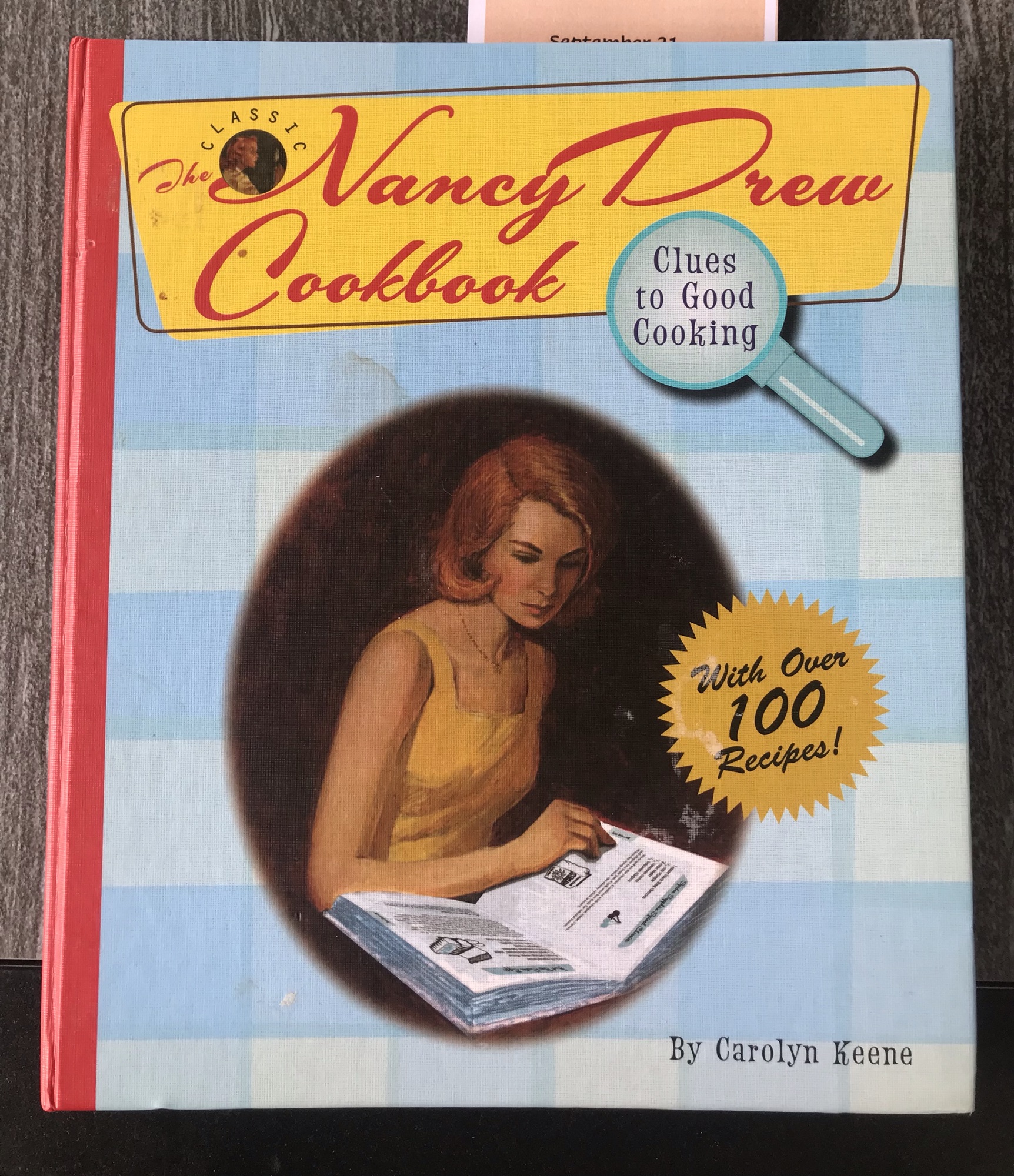
The recipe is as follows:
- 1 cup Cooked Rice, or 3 tbsps Raw Rice, boiled
- 3/4 cup Half-and-Half Cream
- 1/2 cup canned Pumpkin
- 2 cups canned Chicken Broth
- 2 tsps Lemon Juice
- 2 tbsps Sugar
- Cook the Rice as directed on the package, then place in the refrigerator. When chilled, put the Rice in a blender with 1/2 cup of Half-and-Half. Blend at low speed until the mixture is smooth. Add the rest of the Half-and-Half (1/4 cup), Pumpkin, Chicken Broth, Lemon Juice, and Sugar. Mix these ingredients with a beater until well blended.
- Put the soup into the refrigerator for at least 1 hour. Serve chilled.
Makes 4 soup cups.
Nancy Tip: If you do not have a blender, use an eggbeater and whip slowly. Beating too fast and too long will turn the cream into butter!

This tasted nicer than it looks, and that’s on me for not properly blending up the rice. As a result, the soup looks.. curdled. It wasn’t curdled, I promise!

I don’t think I have any adjustments to make to this recipe- I’d like to do it again, and this time do it properly. It really was tasty. My ONLY gripe is I’m very unaccustomed to cold soup. Cold soup feels wrong. However, I still recommend.
 Philosodrama
Leave a comment