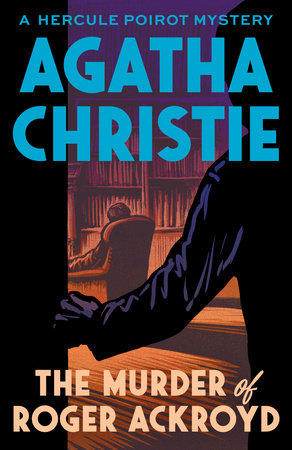

In The Murder of Roger Ackroyd, Hercule Poirot returns after a short-lived retirement, when village King’s Abbot becomes home to the murder of wealthy Roger Ackroyd, owner of Fernly Park. Before his death, Roger had just received a note identifying the blackmailer of the recently dead Mrs. Ferrars, his secret fiance who had killed herself. Joined by narrator and local physician Dr. Sheppard, Poirot sniffs out the murderer among the suspects of a philandering, perpetually broke step-son, suspicious maids, an old friend recently returned from Africa, a preppy young secretary, and a broke, dependent niece and her mother who had come to live with him.
Spoilers ahead!
So! This is apparently one of Christie’s most controversial stories.
First off, I thought this was a very good one. Easy to read and page-turning, and really keeps you guessing. My choice? Geoffrey Raymond. He was just too preppy all the time, and, I thought, a little hollow.
Youth is very buoyant. Even the brutal murder of his friend and employer could not dim Geoffrey Raymond’s spirits for long. Perhaps that is as it should be. I do not know. I have lost the quality of resilience long since myself.
I thought that was a thoughtful observation. Sounds like something I’d say about myself, but I’m of the belief these days that resilience can be regained.
Also, Flora’s mother says near the end that there was a time when Raymond and Flora were nearly dating. I got very excited thinking that was a subtle hint towards motive. As always, I was wrong, but I think the appeal of Christie is not in outsmarting her, but in letting her surprise you. She takes you on for a good ride, so why not let her?
And the murderer was… DR. SHEPPARD! I’ve gotten used to the idea that Christie makes her narrators into murderers. I’m onto this trick of hers. Was I still surprised? YES! And actually, I didn’t particularly like it. I was really liking Dr. Sheppard, and he turns out to be enormously cold-hearted. Blackmailing Mrs. Ferrars was distasteful; killing Roger Ackroyd was evil. He is absolutely remorseless to the end. And he killed, by his own admission, a really good man:
[Ackroyd has just described when Mrs. Ferrars confessed to him that she had murdered her husband]:
I saw the repulsion, the horror, in Ackroyd’s face. So Mrs. Ferrars must have seen it. Ackroyd is not the type of the great lover who can forgive all for love’s sake. He is fundamentally a good citizen. All that was sound and wholesome and law-abiding in him must have turned from her utterly in that moment of revelation.
I think the ending was a little weak. Dr. Sheppard comes off like a sociopath. And here’s the controversy: I am no fan at all of Hercule Poirot’s suggestion of Dr. Sheppard taking his own life by poison to avoid public disgrace. What a soulless idea. Is that justice for the victim?
I’ve read a little of Christie out of order, so I know in the novel of Murder on the Orient Express, Poirot takes a similarly loose view of law and order (with very different results). Spoiler alert! That story ends with Poirot letting all the murderers go free. The Murder on the Orient Express movie (2017), which I actually really like, is a deeply philosophical film. It has Poirot struggle with his understanding of right, wrong, and justice in a way that is, and I can’t overstate this enough, absolutely 100% absent from the novel. It’s not a perfect movie, but it philosophizes, which I’m a big fan of (see title of blog).
Christie is not philosophical. It’s just not how she is. I’m reading her autobiography, and it’s not how she is.
However, speaking on philosophy, we have a small theological reference here!
“Providence,” declared Mrs. Ackroyd. “I have a devout belief in Providence- a divinity that shapes our ends, as Shakespeare’s beautiful line runs.”
“Surely you don’t make the Almighty directly responsible for thick ankles, Mrs. Ackroyd, do you?” asked Geoffrey Raymond, his irresponsible laugh ringing out.
This is a short, glib line, but I think it refers to some real thoughts on the matter. God controls everything? Even down to the ridiculous? (Yes.) As she put Providence in the mouth of silly Mrs. Ackroyd, I’m inclined to think Christie disagrees.
Overall, great read, I really enjoyed myself and I read it quite fast. What did you think of The Murder of Roger Ackroyd?
Stuffed Vegetable Marrows

This recipe was a tad laborious, just due to chopping all the fresh herbs, but was not technical or difficult at all. It came from the wonderful Recipes for Murder by Karen Pierce:
The recipe is inspired by Hercule Poirot’s retired hobby of choice: growing vegetables. However, he is not very good at it, and in his frustration, mistakenly throws a marrow at our narrator.
The ingredients are as follows:
- Salt
- 4-6 Zucchinis
- 4 cloves Garlic
- 1 tbsp finely chopped Fresh Sage
- 1 tbsp finely chopped Fresh Thyme
- 1/2 tbsp finely chopped Fresh Rosemary
- 1 pinch Ground Black Pepper
- 1 tbsp Olive Oil
- 1 large Yellow Onion
- 1 lb Lean Ground Beef
- 1 1/2 cups Diced Tomatoes
- 1 tbsp Tomato Paste
- 2 tbsps finely chopped Fresh Parsley
- 1 large Egg
- 2 ozs grated Parmesan Cheese
- 2 ozs grated Pecorino Cheese
I want everyone to buy this cookbook, so here’s a pared down version of the recipe:
- Preheat oven to 350 degrees.
- Bring a large pot of water to a boil.
- Cut Zucchini in half, and carve out a valley inside each. Put the seeds and pulp aside.
- After the water reaches a boil, add the Zucchini halves and kill the heat. Let sit in the water for 5-10 minutes.
- Remove from the Zucchini from the water, and put aside.
- Crush or grate the Garlic and add to a small bowl, and then add the Sage, Thyme, Rosemary, Black Pepper, and a pinch of Salt.
- In a large frying pan, add the Olive Oil and Onions and cook for about 10 minutes.
- Add the Garlic Herb mixture to the onions, and stir.
- Add the Beef, and cook for 10 more minutes, stirring regularly.
- Chop the Zucchini seeds and pulp.
- Add the Zucchini seeds and pulp, Diced Tomatoes, and Tomato Paste. Cook for another 10 minutes.
- Add half the Parsley, stir, and remove pan from heat.
- Let the mixture cool for 10 minutes. Beat the Egg.
- When the mixture has cooled, add the Egg and half of each Cheese and stir.
- In a greased roasting dish, place the Zucchinis, cut-side up.
- Fill with the stuffing mixture, and sprinkle with most of the remaining Cheese.
- Bake for 30-40 minutes.
- Let the Stuffed Zucchini rest for 5 minutes.
- Sprinkle the remaining Cheese and Parsley over the Zucchinis, and serve.
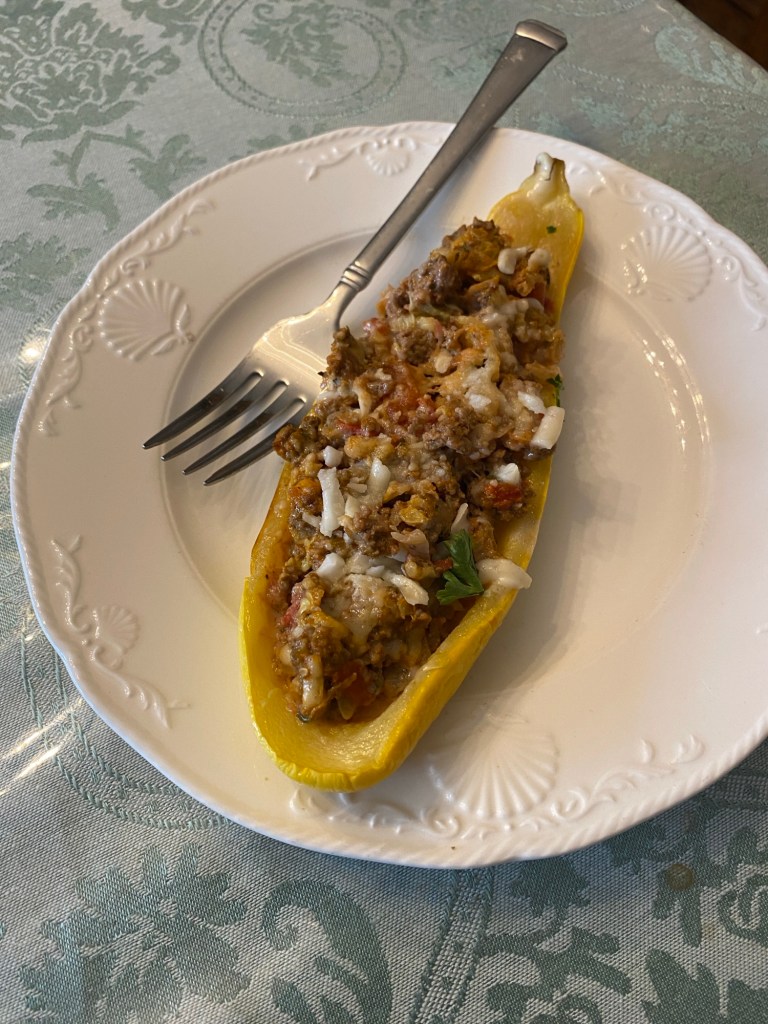
I thought this was very yummy, and perhaps spiced a bit too strongly, though I’m not sure by what. Possibly the rosemary. It took me over three hours to make, but I was working quite leisurely. I ran into no real roadblocks or troubles; it is really a straightforward recipe. It was a hit with my oldest sister and mother, so I’ll probably make it again!
 Philosodrama
Leave a comment